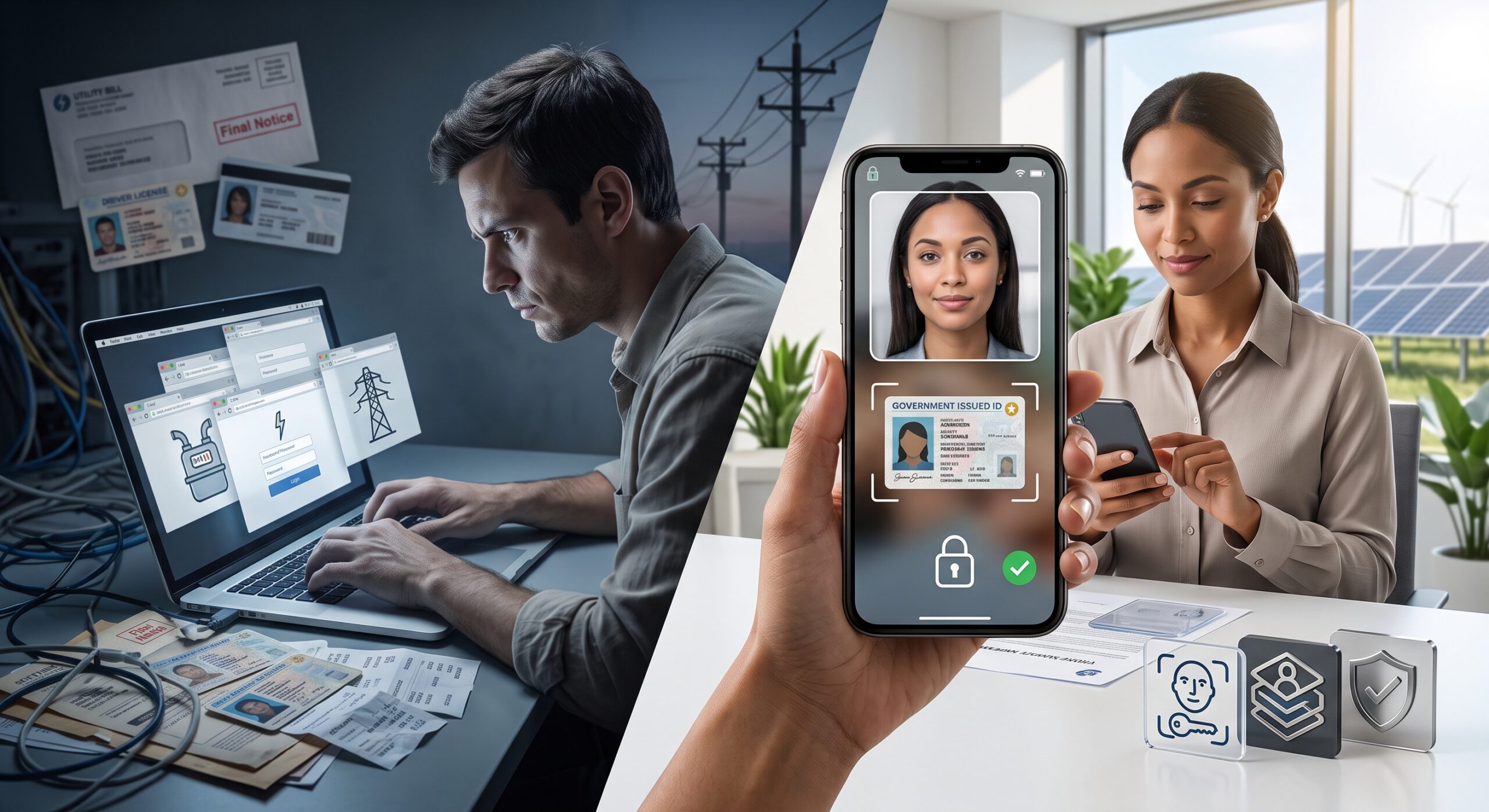
Why Utility Companies Are Easy Targets for Identity Fraud, and How to Close the Gap
Key takeaways
- Utility accounts are often targeted for identity fraud because legacy onboarding relies on static data checks, and billing cycles combined with notice-and-cure regulations delay detection for months.
- Synthetic identity fraud, AI-personalized scam outreach, and deepfake attacks on verification systems are escalating the threat landscape.
- Weak verification exposes utilities to chargebacks, regulatory risk, and unrecoverable revenue, while fraudsters use utility bills as gateway "proof of residence" documents to breach banks and financial platforms.
- The fix is real-time verification at signup, checking a government-issued ID against a live selfie or liveness check without creating friction that violates state accessibility rules.
- Lightico's identity verification (IDV) capability, part of its broader journey orchestration platform, closes this gap by verifying customers in real time inside the utility's own website, app, or contact center flow.
Opening a utility account is often easier than opening a bank account, and fraudsters know it.
While banks enforce strict "Know Your Customer" (KYC) onboarding, utility sign-ups often require little more than a name, address, and Social Security number. Combine these minimal checks with 30- to 60-day billing cycles, and criminals gain a wide window of free service before any red flags trigger.
For utilities operating across multiple state-regulated territories, this exposure compounds quickly. Every unverified account movement creates another point of failure, costing providers millions in unrecoverable revenue, chargebacks, and regulatory risk.
Stopping this fraud doesn't require regulatory overhauls or sluggish onboarding. It simply requires verifying identity at the exact moment an account is opened. Here is why utilities have become prime targets for identity fraud, and how digital-first verification closes the gap.
Why utilities are attractive fraud targets
Three structural gaps make utility accounts an easier mark than most other regulated services.
Weak identity checks at onboarding
Compared to banks, many utilities struggle with legacy onboarding checks that fail to stop modern fraudsters. While utilities are federally required to prevent identity theft under the FTC’s Red Flags Rule, traditional compliance relies on passive database lookups like checking a name against a Social Security number. Fraudsters easily bypass these static checks using stolen or synthetic identities and because utilities lack bank-grade "Know Your Customer" (KYC) verification at signup, bad actors open accounts undetected.
Slow detection and Disconnection Realities
Standard billing cycles stretch 30 to 60 days, giving bad actors weeks of free electricity, gas, or water before red flags trigger. Compounding the issue, state-mandated notice-and-cure regulations require utilities to issue formal warnings before shutting off service for non-payment. When combined with seasonal shutoff moratoriums, a single unverified account can result in months of unpaid service and unrecoverable revenue before the account can legally be closed.
Gateway to Higher-Tier Financial Fraud
Utility accounts are prime targets not only for stolen service, but because an official utility bill is the gold standard for "proof of residence" across the web. Criminals open fraudulent utility accounts specifically to obtain a billing statement, which they then use to pass identity checks at banks, crypto exchanges, and government assistance programs. Stopping utility fraud at registration prevents bad actors from creating the documentation needed to fuel broader financial crimes.
AI is escalating fraud on multiple fronts
Three developments are raising the stakes for utilities specifically.
Synthetic Identity Fraud
Synthetic identity fraud blends real personal data, such as a valid Social Security number, with fabricated names and details. It is difficult to catch precisely because it does not map to a single real victim who can report it. That absence of a clear victim makes it especially persistent across regulated industries.
Targeted Scam Outreach
AI is making customer-facing scams sharper and cheaper to run. Fraudsters use AI to analyze a potential victim's online presence and personalize scam outreach, as well as generate geographically targeted ads that appear when people search for terms related to their energy bills. AARP's Director of Fraud Prevention Programs, Kathy Stokes, has described this shift as giving scam operations an industrial-scale leap in capability.
Deepfakes vs. Verification Systems
AI is being turned against verification systems as well, not only against customers. The Financial Action Task Force's December 2025 Horizon Scan on AI and deepfakes found that fraud detection has not kept pace with generative AI, and that deepfake images, video, and audio can pass through liveness and biometric checks undetected until later in the review process. For a utility, that means the same ID-and-selfie check built to stop fraud can itself become a target, which is why the quality of the liveness detection behind a verification flow matters as much as having one at all.
As customer-facing scams increase, legitimate utility verification requests are increasingly mistaken for phishing, which can leave real customers hesitant to complete a signups.
What weak verification actually costs utilities
The cost isn't only the value of stolen service. It shows up in a few places at once:
- Chargebacks and unrecoverable losses on accounts that never should have opened in the first place.
- Regulatory and compliance exposure, particularly where state commissions require documented verification steps for deposits, payment agreements, or assistance enrollment, and particularly for utilities managing different rules across multiple service territories.
- Erosion of customer trust when a utility's own legitimate verification request gets mistaken for the scam it's trying to prevent.
What closing the gap looks like
Closing the gap comes down to verifying identity once, correctly, at the moment an account opens, in place of detection that happens weeks later after the damage is done.
That means checking a government-issued ID against a live selfie or liveness check at signup, in place of relying on static data points like a name and a billing address.
Because Public Utility Commissions hold utility providers to strict accessibility standards, any verification system must balance security with ease of use. Lightico's identity verification flow operates directly inside the utility's own website, mobile app, or contact center workflow. Customers upload an ID and complete a guided liveness check in the channel they already trust. Contact center agents can initiate the exact same mobile flow during phone signups, ensuring that vulnerable, unbanked, or less tech-savvy populations receive guided support while maintaining full regulatory compliance.
IDV sits inside Lightico's broader journey orchestration platform, which also handles e-signatures, document collection, and workflow automation. Utilities can apply AI-powered intelligent document processing (IDP) to supporting paperwork like proof of income or assistance program applications, validating supporting documents automatically instead of reviewing them line by line in an email inbox.
A familiar before-and-after
Consider a large electric utility that, until recently, asked new customers to email a photo of their driver's license and a selfie before service could be activated. Those images sat in a shared inbox until an agent had time to review them by eye, with no automated check that the face matched the ID or that the ID itself was genuine, and no reliable way to know how many fraudulent applications slipped through while the request waited. Moving that same check into a real-time, guided flow at the moment of signup turns a slow, unvalidated manual step into an automated one that happens before the account is ever created.
Utilities including Southern Company and PECO already use Lightico's identity verification product for this kind of onboarding check.
Done this way, verification replaces manual document review and emailed attachments with a guided flow that takes minutes, delivering a stronger identity check and a faster signup together.
See Real-Time Identity Verification in Action
Learn how leading utility providers stop onboarding fraud without adding friction for legitimate customers: Explore Lightico Identity Verification.
Ready to see how it works on your customer journey? Request a Demo.
Frequently asked questions
Why are utilities targeted by identity fraud?
Utility onboarding historically relied on passive data checks rather than active identity verification. When combined with standard billing cycles, state-mandated notice-and-cure periods, and the value of a utility bill as proof of residence, fraudsters gain an attractive window to exploit accounts.
What is synthetic identity fraud?
Synthetic identity fraud combines real personal data, such as a valid Social Security number, with fabricated names and details to create a new identity that doesn't belong to any single real victim, making it harder to detect through traditional credit checks.
How can utilities verify identity without adding friction?
By running a real-time ID and selfie or liveness check inside the utility's own website or app at the moment of signup, the approach Lightico's identity verification product uses, rather than relying on emailed documents or a third-party redirect that a customer may not trust.
How can utilities satisfy PUC accessibility requirements while verifying identity?
By offering multi-channel verification. Automated digital flows allow self-service customers to verify on their phones, while contact center agents can trigger guided text-to-screen flows during phone-assisted signups to assist customers who need extra support.
Does stronger verification slow down customer onboarding?
Not when it is embedded directly into the signup flow. A guided, mobile-friendly verification step takes under two minutes and eliminates slow manual tasks like emailing document attachments or waiting for manual back-office reviews.
Glossary
Identity verification (IDV)
The process of confirming that a person opening an account is who they claim to be, typically by checking a government-issued ID against a live selfie or liveness check. For utilities, IDV is the step that closes the onboarding gap described above, and it's one of the core capabilities within Lightico's journey orchestration platform, alongside e-signatures, document collection, and workflow automation.
Know your customer (KYC)
A set of identity verification requirements originally built for banking, designed to confirm a customer's identity before opening an account or providing a service. Utilities have historically operated without KYC-grade checks, which is part of why they're an easier fraud target. More on KYC and compliance.
Synthetic identity fraud
A form of fraud that combines real personal data, such as a valid Social Security number, with fabricated names and details to create a new identity that doesn't belong to any real victim. It's one of the most common ways fraudsters open utility accounts, since a name-and-SSN check alone can't catch it.
Liveness check
A verification step that confirms a selfie or video was captured in real time by a live person, rather than a photo of a photo or a static image, to prevent spoofing. This is what lets a utility verify a new customer remotely, over a phone camera, without requiring an in-person visit, and it's the mechanism behind Lightico's identity verification flow.
Deepfake
AI-generated or AI-manipulated image, video, or audio built to convincingly mimic a real person or document, increasingly used in attempts to spoof identity verification and liveness checks. As utilities move more onboarding online, this kind of attack is why the quality of the liveness detection behind a verification flow matters as much as having one at all.
Chargeback
A reversal of a payment, or an unrecoverable loss a company absorbs, when a transaction, such as a fraudulently opened utility account, turns out to be invalid. Verifying identity at signup is what keeps a fraudulent account from being opened in the first place, which is where chargeback exposure starts.
Shutoff moratorium
A regulatory rule that temporarily prohibits utilities from disconnecting service, often during extreme weather or financial hardship, intended to protect vulnerable customers. It's a utility-specific protection that fraudsters can exploit to stretch out service on an account before it's flagged, part of why utilities face a different fraud profile than other regulated industries.
Onboarding
The process of signing up a new customer and opening their account, from initial application through activation of service. It's also the single point where identity verification, done well, closes the fraud gap described throughout this piece.
About Lightico
Lightico is a journey orchestration platform that helps regulated industries, including utilities, banking, auto finance, insurance, and telecommunications, complete complex customer interactions in a single digital session. Its capabilities include identity verification, e-signatures, document collection, and workflow automation, letting businesses move a customer from first contact to a completed, compliant transaction without switching tools or channels. Utilities including Southern Company, PECO, and BT rely on Lightico to modernize onboarding, billing, and compliance workflows across self-service and contact center channels. Learn more at www.lightico.com.

